No GEO Without SEO — But SEO Alone Won't Get You Cited
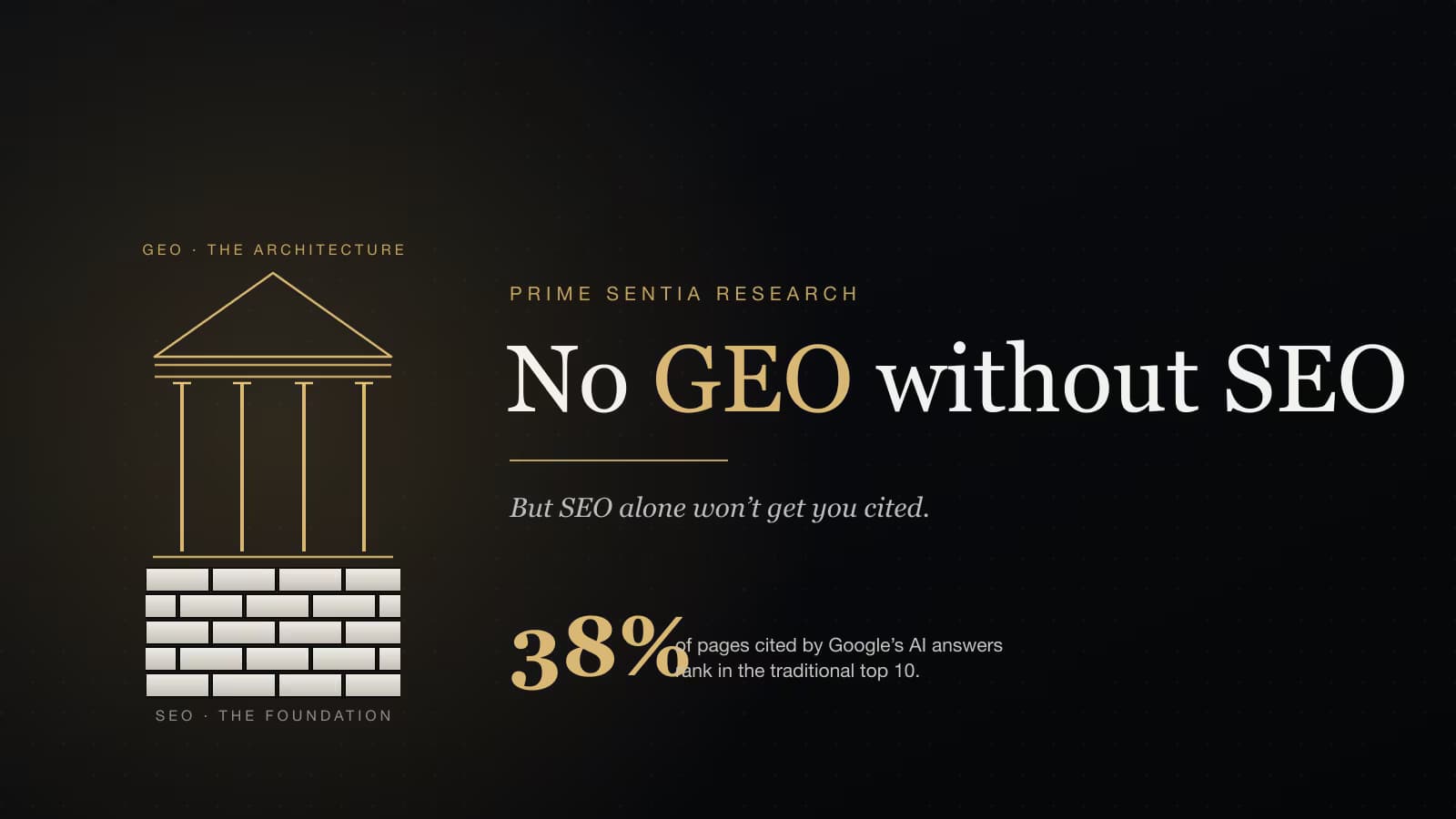
SEO and GEO aren't rivals — they're two trades. SEO builds the crawlable, authoritative foundations an engine can reach; GEO designs citability on top. Only 38% of pages cited by Google's AI answers rank in the traditional top 10.
By Luis Oleart4 min readThe key point up front: SEO and GEO aren’t rivals, and one doesn’t replace the other. They’re two trades. SEO materializes the foundations an engine can reach — crawlability, authority, infrastructure. GEO designs citability on top of them — extractability, entity clarity, clean attribution. The error most teams make isn’t picking the wrong one. It’s assignment: asking one trade to do the other’s job. And the data shows the gap plainly — only 38% of pages cited by Google’s AI answers rank in the traditional top 10.
Two loud claims dominate the GEO conversation, and both are wrong. One says GEO replaces SEO — throw out the old playbook. The other, Google’s own framing, says GEO is just SEO — nothing new here, keep optimizing as before. The truth sits between them, and the difference is worth money.
The data that settles it
If GEO were just SEO, the pages that AI engines cite would be the pages that already rank. They aren’t. An Ahrefs analysis (February 2026) found that only 38% of pages cited in Google’s AI Overviews sit in the traditional top 10. Nearly two-thirds of what AI recommends comes from outside the ranking winners. The signals that earn a citation are not the same signals that earn a ranking. That single number is the whole argument: two overlapping disciplines, not one.
Two trades, not a hierarchy
A useful way to see it: the architect and the bricklayer. The bricklayer materializes what you can touch — lays the foundation, sets the load-bearing walls, makes the thing real. The architect designs for a purpose you can’t touch — how the structure holds, how it reads, what it’s for. Neither outranks the other. A brilliant design with no foundation is a drawing; a solid foundation with no design is a pile of well-laid bricks.
SEO is the bricklayer. It builds the crawlable, authoritative, technically sound site an engine can actually reach. GEO is the architect. It shapes that material so a generative engine can extract a passage, trust it, and attribute it cleanly. The same site can be strong on one and invisible on the other.
The error is assignment, not rank
Watch what happens when the trades get crossed. A page with real domain authority — the bricklayer’s best work — can be invisible to Perplexity if its claims are buried, ambiguous, or structurally hard to attribute. The foundation is there; no architect designed it to be cited. Run it the other way: a beautifully answer-first, extractable page earns nothing if no crawler can reach it. The design is there; no bricklayer laid the ground.
Teams keep asking the bricklayer to design and the architect to lay bricks — expecting schema to rescue weak content, or expecting brilliant content to get cited without structure. Neither works, and neither is a failure of the trade. It’s a failure of assignment.
Why “GEO is just SEO” is the expensive misread
Google says optimizing for AI is still, at its base, SEO — and there’s real overlap. Crawlability, authority, and useful content are prerequisites for both. But “prerequisite” is not “sufficient.” SEO gets you into the room; GEO gets you quoted. The 38% is the cost of stopping at the room. If you treat citability as a byproduct of ranking, you inherit the two-thirds gap — you rank, and the AI recommends someone else.
All constants are variables. “Good SEO is enough” was a constant for twenty years. The answer layer just turned it into a variable.
What this means for content teams
- No GEO without SEO. Without crawlable, authoritative foundations there is nothing for an engine to cite. The bricklayer goes first.
- But SEO alone won’t get you cited. Ranking is shelf space; citation is the recommendation. They’re earned by different signals.
- Don’t cross the assignment. Schema won’t save weak content, and strong content won’t get cited without structure. Fix the right layer.
- Measure both — deterministically. Estimating citability from ranking proxies inherits the 38% gap. Measure what an engine can actually extract, not what you hope it will.
The error was never GEO’s or SEO’s. It was putting them to do each other’s work.
See also: AI Killed the Mobile Star — why your audience isn’t only human anymore.
Do your pages rank — or do they get cited? → Run a Live GEO Audit