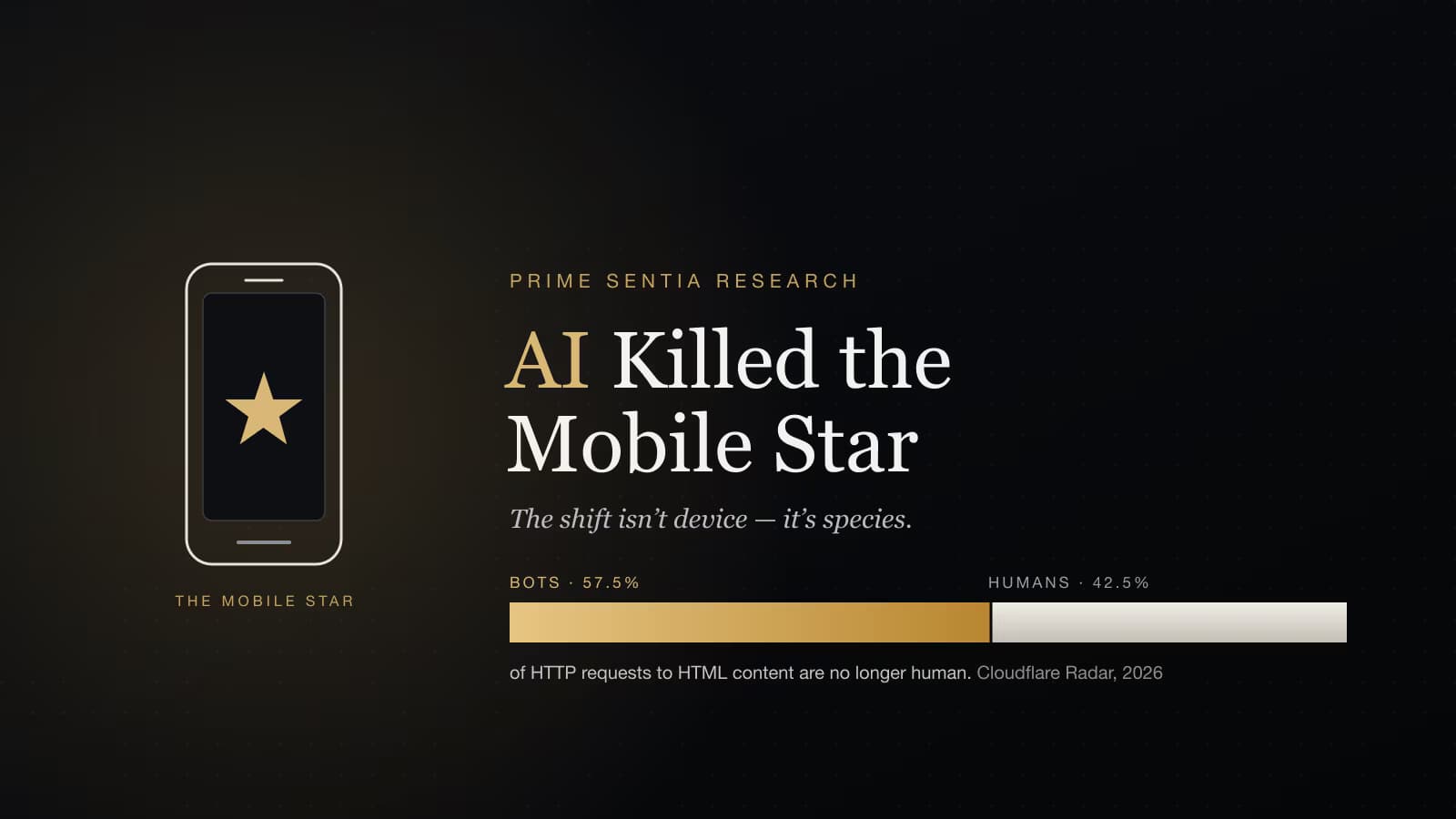
AI Killed the Mobile Star
Pull raw web traffic and desktop looks like it is winning again — until you filter the bots, and humans are still mobile-first. Bots are now 57.5% of requests to HTML content. The real shift isn't device, it's species: human or agent?
By Luis Oleart4 min readThe key point up front: mobile-first didn’t die because humans went back to the desktop. It died because bots dress up as desktop. Filter them out and humans are still mobile-first. What changed isn’t the device — it’s the species of visitor asking for your page. And more than half of them are no longer human.
The Buggles sang that video killed the radio star. The radio star didn’t die, of course — it changed jobs. The same reframing is happening to the mobile-first web, and the data finally makes it undeniable. But look closely, because the obvious reading is the wrong one.
The number looks like mobile-first is over
Pull raw web traffic and desktop is winning again. In Cloudflare Radar’s data for the 28 days to 22 June 2026, desktop generated about 56% of requests and mobile about 43%. After a decade of “design for the thumb first,” that looks like a reversal — the desktop comeback that ends the mobile era.
It isn’t. That’s the all-traffic view: every HTTP request hitting the network, bots included. And the bots are the whole story.
Filter the bots and the number flips
Filter Radar’s data to likely-human traffic and the split inverts: humans are still mobile-first, around 56% of human requests coming from phones. The all-traffic desktop majority is an artifact — bot traffic runs roughly 85% desktop user-agents, and that mass drags the headline toward desktop. Your human audience never left the phone. The desktop “comeback” is a costume.
This is the trap in a single dataset: the same source says mobile-first is dead and mobile-first is alive, depending on which population you count. Design for the raw number and you optimize for a majority made of machines.
The real shift isn’t device — it’s species
Here’s the number that matters. Bots now account for 57.5% of HTTP requests to HTML content; humans, 42.5%. For the first time in the web’s history, most requests are not from people. Cloudflare’s CEO Matthew Prince expected this crossover at the end of 2027 and it arrived around eighteen months early, in mid-2026 — fast enough that he admitted it caught him off guard. He frames it as a platform shift on the scale of desktop-to-mobile. The difference is pace: mobile took a decade; this took months.
The culprit isn’t the old wave of scrapers and search crawlers. It’s agentic AI — assistants that fetch dozens or hundreds of pages per query, on a human’s behalf, without ever rendering the page a person would see.
Mobile-first was a rule about humans. Your traffic isn’t only human now.
Mobile-first was never wrong. It was a correct rule for an audience that was entirely human and increasingly on phones. That rule still holds — for the humans. What’s new is that the humans are now a minority of the requests, and the other half doesn’t have a thumb, a screen, or a viewport. It has a parser.
So the question every content team optimized around — “mobile or desktop?” — has quietly become the wrong question. The one underneath it is “human or agent?” — and the answer is trending agent. Designing only for the human phone is designing for the shrinking half.
All constants are variables. Mobile-first was a constant for ten years. It just became a variable, and the thing that moved it wasn’t a device. It was a new kind of reader.
What this means for content teams
- Split your metrics. All-traffic and human-only are different populations. Designing for the blended number means designing for no one in particular.
- Keep mobile-first — for humans. The rule isn’t dead; it’s now half the job. Your human visitors are still on phones.
- Add agent-first. The other half doesn’t render your page — it fetches and extracts. Structure, clean markup, and retrieval-ready content are how you serve a reader with no screen.
- Change the question. Not “mobile or desktop,” but “is my page legible to the agent that now makes up the majority of my traffic?”
The mobile star didn’t die. It just stopped being the whole audience.
Is your site legible to the readers that are now the majority? → Run a Live GEO Audit