Why Google's Top 10 No Longer Saves You
AI engines like ChatGPT and Perplexity don't read link lists—they read entities. Empirical data, the operational gap between SEO and GEO, and why visibility is now a citability problem.
Este artículo también está disponible en español.
This gap is not an algorithmic glitch or a passing anomaly. It reflects the most profound structural shift in the information economy since the inception of PageRank: the transition from the era of link indexing to the era of entity synthesis.
If your business still measures digital presence solely through average ranking position across a list of ten blue links, you are optimizing for a distribution channel that users are rapidly replacing with conversational search assistants.
The Data That Dismantles the Ranking Dogma
When Google deployed generative answer snapshots and engines like ChatGPT Search and Perplexity achieved mainstream enterprise adoption, the default assumption among marketing agencies was predictable: “AI models will simply summarize the top three organic results already sitting on page one.”
Empirical data has decisively debunked that assumption:
- Decoupling Citations from SERP Rank: Ahrefs’ cross-industry study examining millions of live queries confirmed that nearly two out of every three citations in Google AI Overviews originate from domains ranking lower down the SERP or competing in semantic long-tail corridorscite-ahrefs.
- The Surge of Zero-Click Journeys: Analysis by Bain & Company reveals that over 60% of informational inquiries now conclude without the user ever clicking an external hyperlinksrc-bain-search. Brand evaluation and user consensus are forged directly inside the synthesized response (the Answer Layer).
- The Measurable Impact of Structured Optimization: Princeton NLP’s landmark academic research on Generative Engine Optimization (GEO) demonstrated that applying explicit citability optimizations (authoritative source citations, atomic factual claims, and unambiguous terminology) increases relative visibility within generative engines by up to 40%cite-princeton.
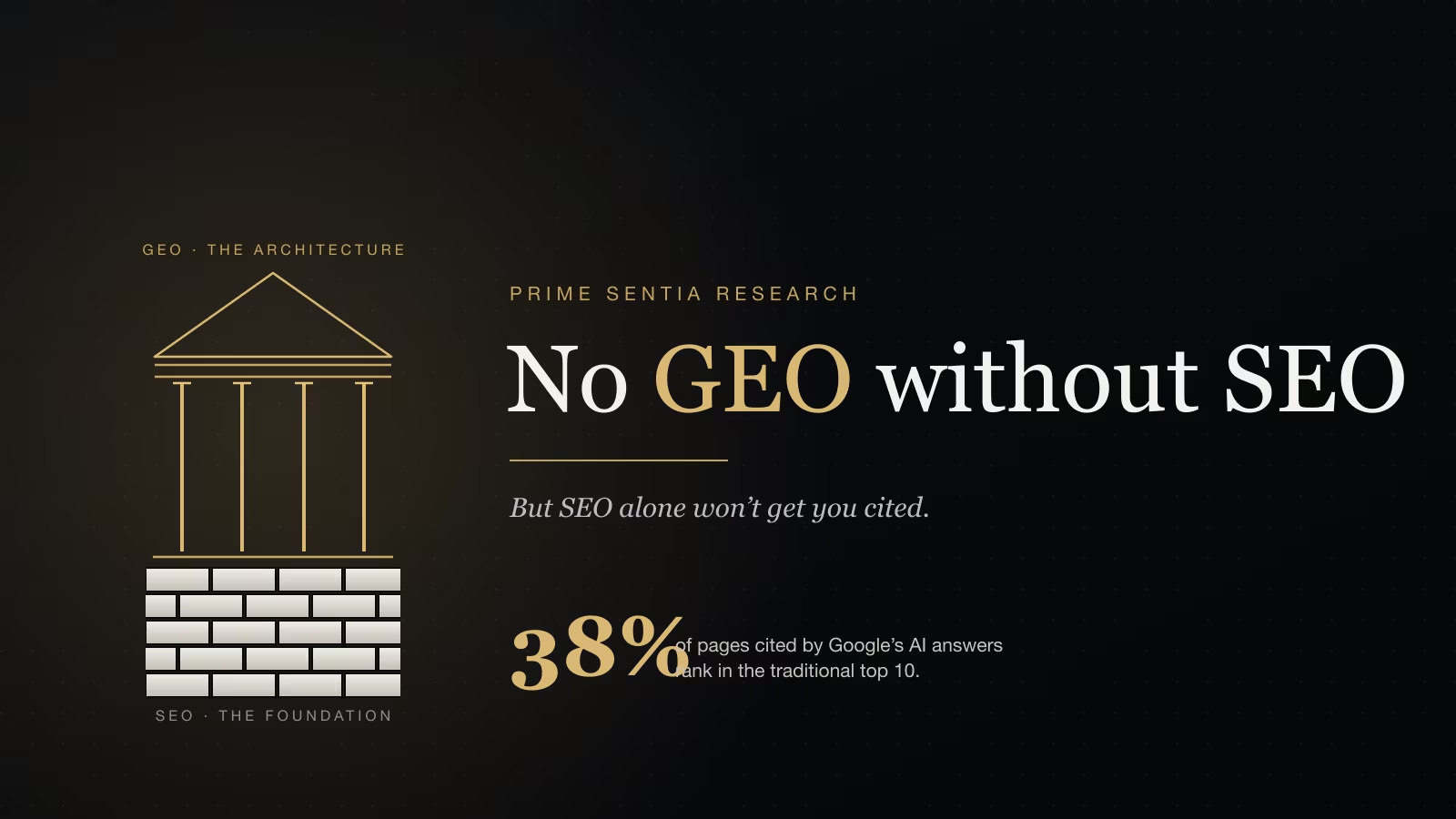
Two Separate Crafts: The Bricklayer and the Architect
The recurring blunder in executive strategy sessions is treating GEO and SEO as adversarial disciplines, or assuming one renders the other obsolete. In reality, they are two interdependent, complementary crafts:
- SEO is the bricklayer: It pours the foundation, erects load-bearing walls, and ensures the structure is physically accessible. It solves crawlability, indexing speed, Core Web Vitals, URL hierarchy, and authority transference through hyperlinks.
- GEO is the architect: It designs the semantic interior, spatial utility, and meaning of the environment. It guarantees that when an LLM inspects the page, it can extract self-contained atomic passages, identify unambiguous entity identities, and link every assertion to a verifiable source.
| Dimension | Traditional SEO | Generative Engine Optimization (GEO) |
|---|---|---|
| Surface of Impact | Organic search engine results pages (SERPs). | Synthesized generative responses (AI Overviews, ChatGPT, Perplexity). |
| Primary Metric | SERP position (ranking, CTR, organic clicks). | Citation frequency, attribution share, and AI brand share-of-voice. |
| Unit of Analysis | The entire URL or document. | The factual passage (citable unit) and semantic entity graph. |
| User Behavior | Active click to consume content on-site. | Direct consumption within the conversational interface (Zero-Click). |
| Critical Risk | Ranking volatility from algorithmic core updates. | Total omission during upstream consideration (upstream brand invisibility). |
Expecting classical SEO to solve visibility inside Perplexity is like hiring a bricklayer to curate an art gallery: the physical construction will be spotless, but generative models will not find the citable evidentiary grounding necessary to include your brand in their answers.
The Three Pillars of Citability in the LLM Era
For content to be citable by a generative engine, voluminous prose and keyword-stuffed articles are counterproductive. Models apply attention mechanisms and semantic filters calibrated for factual density and attribution reliability:
1. Claim Extractability
LLMs do not cite sprawling essays; they cite concrete, standalone propositions. When a core metric, strategic thesis, or definition is diluted across five paragraphs of narrative filler, a generative engine will almost always prefer a competitor that presents that data as an atomic, structured unit.
<!-- Example of a machine-extractable claim block -->
:::claim{source="https://your-domain.com/research"}
In 2026, 62% of AI-generated search citations originate from web pages outside the traditional organic Top 10.
:::
2. Entity Grounding and Trust Schemas (PROV-O & Schema.org)
Generative engines require unambiguous verification of who asserted what and under what credentials. Linking content to persistent global identifiers (ORCID, LinkedIn, Wikidata) using JSON-LD and provenance vocabularies (schema:author, prov:wasGeneratedBy) reduces the model’s hallucination penalty when attributing citations.
3. Semantic Self-Containment (Context Completeness)
A citable unit must be fully intelligible in isolation. If understanding a single finding requires parsing three prerequisite pages or deciphering ambiguous pronouns, the retrieval engine will bypass it in favor of an excerpt that delivers complete context, boundaries, and evidence within the passage itself.
From the “Click Economy” to the “Influence Layer”
When over 60% of search journeys resolve entirely inside the AI interface, raw referral clicks no longer reflect whether a brand is winning or losing mindshare.
Consider a prospective buyer asking: “Which B2B platforms provide enterprise-grade Generative Engine Optimization?” Their shortlist will be established directly from the three solutions the AI describes, compares, and endorses. If your company is omitted from that generative synthesis, you have lost the deal before a website visit could even occur.
The competitive arena has moved decisively upstream. Securing market leadership now demands a dual-engine architecture:
- Maintain rigorous SEO health: Ensuring search crawlers from OpenAI, Perplexity, and Google continuously discover and index your pages.
- Engineer for GEO citability: Structuring your published knowledge so that, once ingested, your brand is retrieved, respected, and quoted as the authoritative benchmark.
Conclusion: Citability Is an Engineering Decision
Debates between traditional SEO veterans and AI evangelists often degenerate into false binaries: one camp claims SEO is dead, while the other pretends nothing has changed.
Both are mistaken. SEO is not dead—but ranking alone is no longer enough to save your pipeline.
Digital visibility is no longer a tactical game of keywords and backlink volume; it is an engineering discipline centered on data architecture, machine citability, and semantic integrity. Brands that engineer their content to be factual, modular, and machine-verifiable will define the answers millions of enterprise decision-makers read every single day.
FAQ
Proudly AI-assisted. Article developed under human direction. Luis Oleart formulated the editorial thesis, citability engineering methodology, and empirical verification.